

Human-Centered Urban Robotics
Urban robots are becoming more than standalone machines. As they enter campuses, neighborhoods, hospitals, transport hubs, and public spaces, they also become service providers, users of shared space, and participants in urban systems. Human-Centered Urban Robotics examines how robots can be integrated into cities in ways that respond to genuine human needs and respect the spatial, social, and institutional contexts in which people live. Our research connects urban design, spatial intelligence, mobility, artificial intelligence, robotics, digital twins, public acceptance, and governance to explore how future human–robot environments can become safer, more accessible, inclusive, adaptive, and socially responsible.

Campus as a Micro-City for Human–Robot Integration
This vision is being developed through the 2026 Red Bird MPhil Project-Based Learning project, Improving Human-Centered Integration of Autonomous Robots in Campus Environments. The HKUST(GZ) campus serves as a micro-city and an open living laboratory where students can investigate how people, robots, buildings, public spaces, mobility systems, environmental conditions, and institutional arrangements interact in everyday life. Rather than beginning with a predetermined robot or technical solution, student teams start by identifying unmet needs and real-world constraints. They then develop focused projects involving service planning, spatial accessibility, behavioral digital twins, pedestrian–robot interaction, environmental sensing, adaptive robot intelligence, physical deployment, public acceptance, and responsible governance.

Human-Centered Urban Robotics Initiative (HURI)
The projects below translate this shared vision into specific research questions, urban scenarios, and robot concepts. Each faculty-led project addresses a different part of the human–robot urban system, while together they contribute to a broader research agenda for understanding, designing, testing, and governing robots in future cities.
HURI-01 Guide Beagle (Cyber Luban 2026)
An Intelligent Reception and Campus Guide Robot for Public Services
Yang YUE
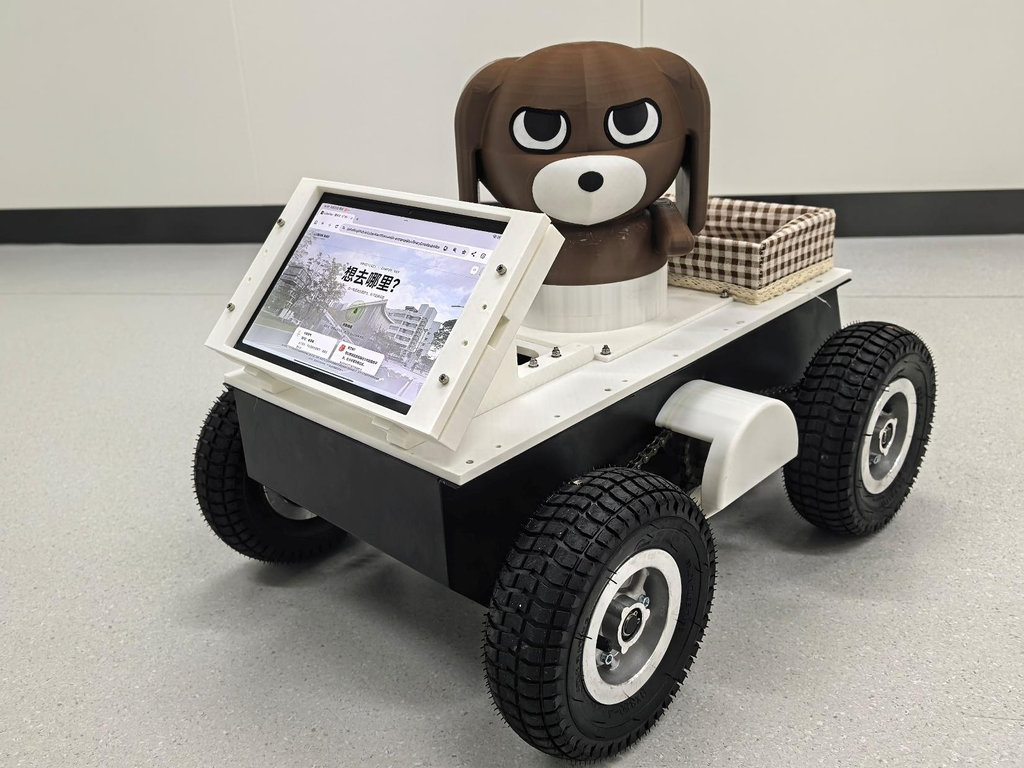
To advance the vision of “human–robot coexistence” in future communities, we designed an intelligent navigation vehicle using campus navigation as a real-world application scenario. From its physical form to its onboard sensors, the system is designed around real-time environmental sensing and human–robot interaction analysis. It aims to enhance the campus navigation experience while providing a practical platform for exploring future cities where humans and robots coexist.
HURI-02 Gardener Robots (Cyber Luban 2026)
Mobile Robot for Campus Mosquito/Insect Control and Vegetation Management
Rushi DAI
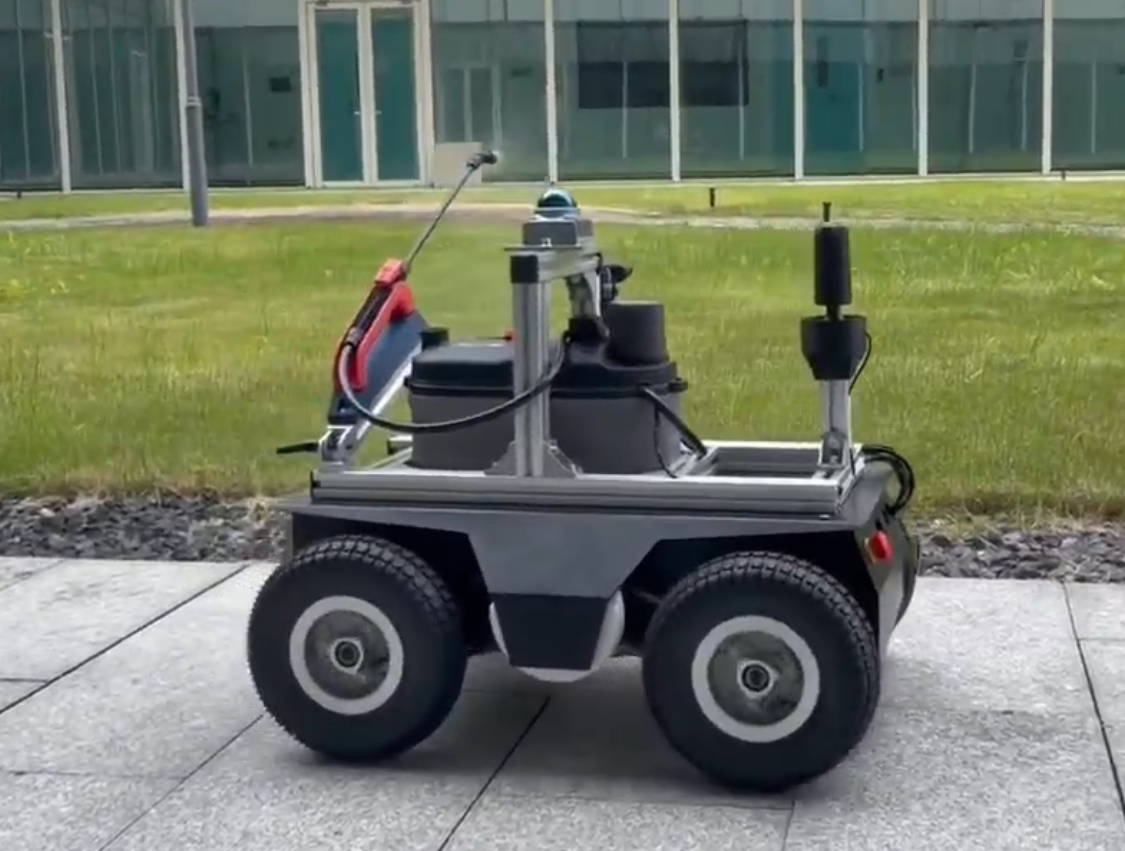
This project develops a mobile intelligent robot for campus scenarios, capable of day-and-night mosquito disinfection and vegetation management. During daytime, it performs harmless operations such as vegetation irrigation; at night, it carries out mosquito disinfection. Adopting a modular design, the robot supports quick replacement of water tanks, pesticide tanks and dedicated tools. Built on a campus rover chassis, the robot integrates LiDAR, RTK high-precision positioning and visual perception to realize autonomous mapping, cruise navigation and obstacle avoidance.
HURI-03 Shared Readership
A continuous-scale spatial structure for task-dependent mapping by humans and autonomous agents
Bin JIANG
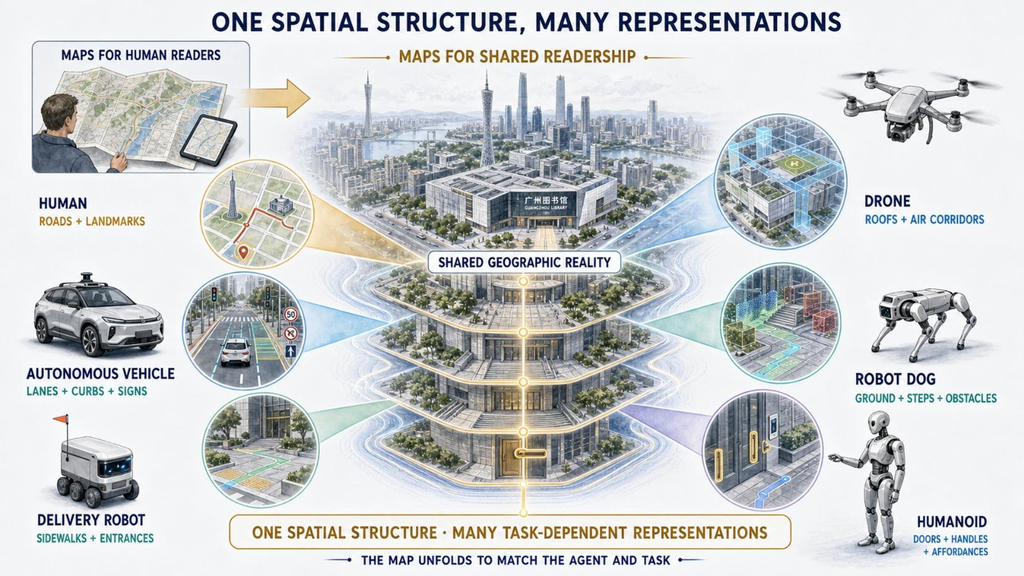
This project investigates how one continuous-scale spatial structure can support multiple task-dependent representations for humans and autonomous agents. Rather than producing separate maps for pedestrians, vehicles, delivery robots, drones, quadrupeds, and humanoids, the proposed framework maintains a shared geographic reality organized through meaningful wholes and parts. It then derives representations suited to each agent's mobility, sensing, reasoning, and action requirements, including roads, landmarks, lanes, curbs, entrances, roofs, air corridors, steps, obstacles, doors, handles, and affordances. The project will develop a prototype, test cross-agent consistency, and evaluate whether shared structure improves navigation, coordination, adaptability, efficiency, safety, interoperability, and spatial intelligence overall.
HURI-04 Wheelchair Robot
Integrated Living-Assistance Wheelchair Robot for the Elderly
Lingbo LIU
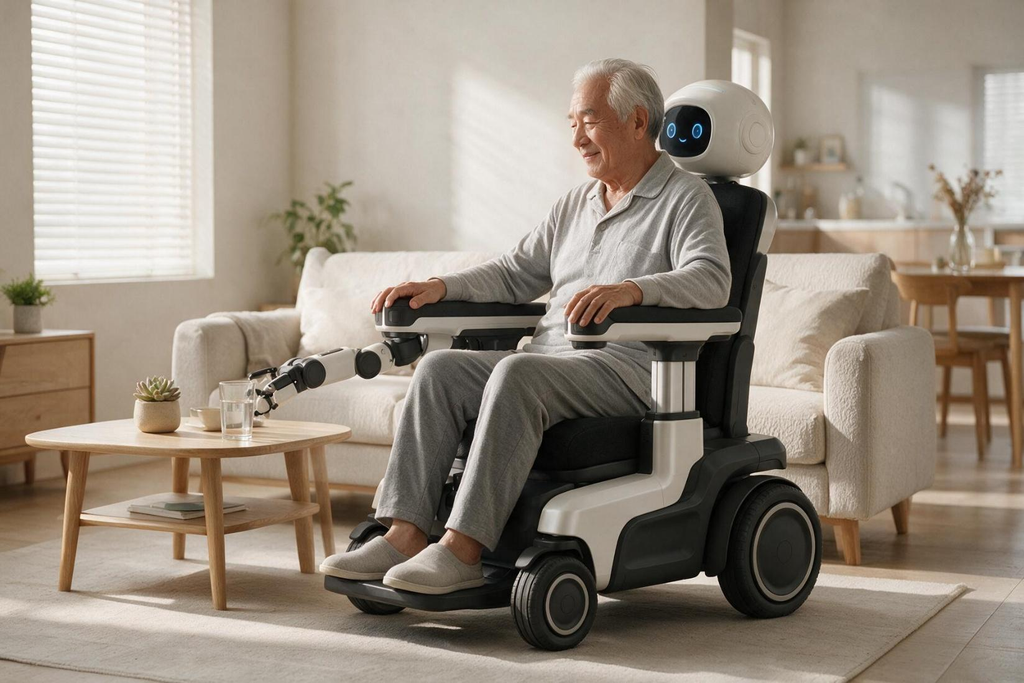
This project targets the indoor independent living needs of healthy, mildly disabled and semi-disabled older adults, and develops an intelligent wheelchair robot integrating autonomous mobility, body support, bed-chair transfer and daily living assistance. The system adopts a wheeled mobile chassis and deformable seat structure, equipped with retractable supporting manipulators on both sides to provide physical assistance and stable support for the elderly to stand up, sit down, transfer between bed and wheelchair, use the toilet and take showers. Meanwhile, a flexible auxiliary manipulator is deployed to grasp and deliver daily objects such as water cups, clothes and medicines.
HURI-05 Campus Delivery Robots
Indoor–Outdoor Autonomous Mobile Robot for Campus Last-Mile Delivery
Wufan ZHAO
This project develops an indoor–outdoor autonomous delivery robot for campus food and small-parcel services. Integrating multimodal perception with Vision-Language-Action (VLA) intelligence, the robot can understand delivery tasks, perceive its surroundings, navigate autonomously, avoid dynamic obstacles, and support secure pickup. Beyond practical campus delivery, the platform also provides a flexible testbed for robotics education, embodied intelligence research, and future multi-robot collaboration in real-world campus environment

HURI-06 Community Planner Robot
LLM-Enabled Humanoid Robots for Scenario-Based Planning Communication and Decision Support
Si QIAO
Community planning often relies on technical drawings and professional terminology that can be difficult for residents to understand, particularly older adults, children, and people without a planning background. This project explores how humanoid robots powered by large language models (LLMs) can help residents understand proposed changes and bring their experiences, concerns, and preferences into planning decisions.
The robot will serve as both a “translator” and an “experience companion.” It will translate planning concepts into everyday language and concrete scenarios that relate to residents’ daily lives. By accompanying residents on community walks, it can explain proposed changes at specific locations, help them imagine how these changes might affect their activities, and encourage them to express their views in relation to the surrounding environment. For example, a discussion about a redesigned public space could focus on where an older resident would rest or how a child would cross the street. In the other direction, the robot will help organize residents’ comments into location-specific needs, concerns, and planning criteria for planners to review and use when comparing or revising proposals.

HURI-07 Road inspection robot
Inspection Robot for 3D Campus Pedestrian Networks
Maosu LI
Cracks, potholes, uplifted paving tiles, and other defects on campus roads not only degrade the aesthetic quality of the campus environment but may also lead to localized water accumulation and soil erosion. They increase travel risks for older adults and people with limited mobility, and impair the traversability and operational stability of wheeled robots. This project aims to develop an intelligent robotic system that integrates autonomous inspection, defect identification, risk early warning, and environmental assessment. By integrating machine vision, LiDAR, and GIS spatial information, it will enable automatic identification, precise localization, and on-site labeling for warning of pavement defects. On this basis, the project will comprehensively assess the traversability friendliness of the road environment for pedestrians and robots, and build a dynamically updated 3D map of campus pedestrian–robot friendliness, thereby providing technical support for campus road maintenance, robot path planning, and smart campus development.

HURI-08 UrbanMesh
Air–Ground Intelligence for Smarter Cities
Jianying WANG
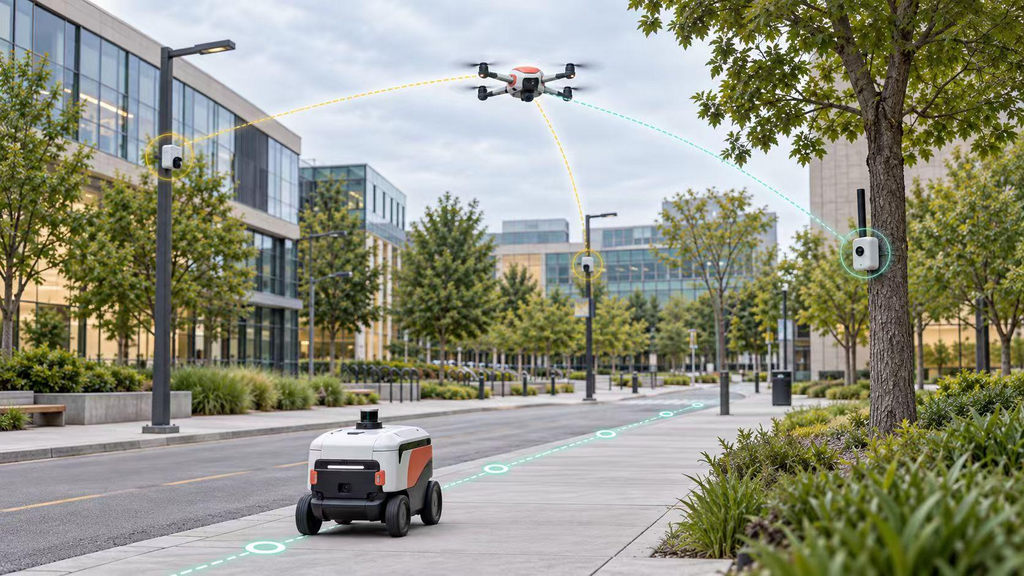
UrbanMesh is an air–ground collaborative robotics project for smarter urban services. Autonomous ground robots support last-mile delivery, street-level inspection, and local environmental sensing, while low-altitude drones provide rapid aerial observation and wider spatial coverage. By sharing maps, sensor data, and task plans, the two platforms can coordinate routes, exchange information, and respond to changing urban conditions. The project explores how integrated robotic fleets can improve the efficiency, safety, and flexibility of city logistics, environmental monitoring, and emergency response, while providing a practical platform for research, prototyping, and real-world experimentation. It also enables students to build systems that work beyond the laboratory.
HURI-09 Space Pulse
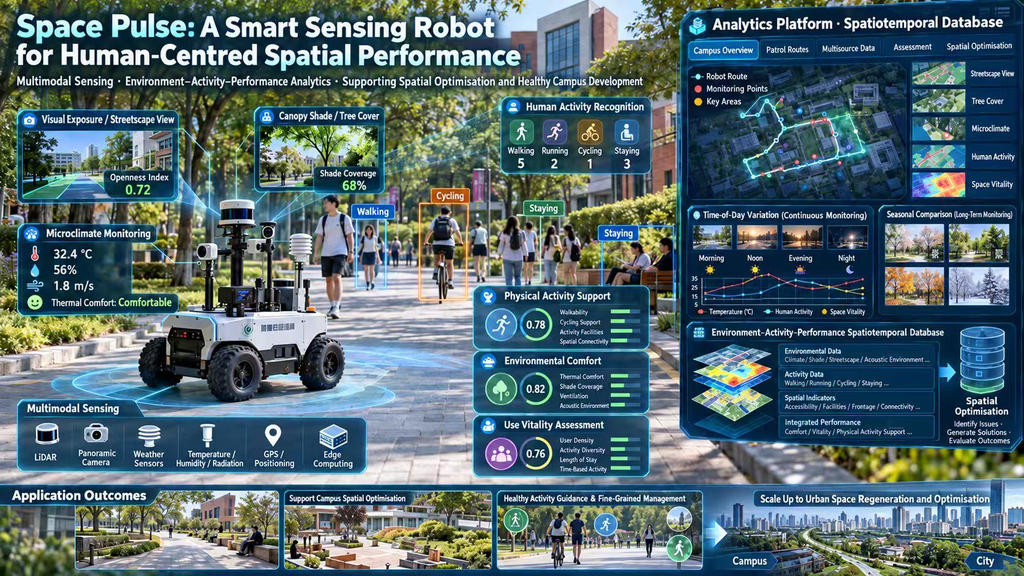
A Smart Sensing Robot for Human-Centered Spatial Performance
Haoxiang ZHANG
Space Pulse Robot will integrate autonomous surveying, multimodal sensing and intelligent analysis to evaluate human-centred performance in outdoor spaces. Using campuses as initial testbeds, the robot will collect real-time data on visual exposure, tree shade, microclimate and human activity along campus roads and in public spaces to assess support for physical activity, environmental comfort and spatial vitality. A spatiotemporal database linking environments, activities and performance across daily and seasonal cycles will reveal how spatial qualities align with activity needs. The project will inform campus design improvements, healthy activity guidance and targeted management, while exploring applications in broader urban regeneration.
HURI-10 Urban Perceiver
Inspection Robots and Environmental Exposure Maps
Qiumeng LI
This project will use an urban inspection robot equipped with cameras, air quality and noise sensors, temperature and humidity sensors, and GPS modules for street-scale mobile data collection. The research will focus on the spatiotemporal alignment of multi-source data, the calculation and visualization of environmental exposure indicators, and continuous street-view image acquisition. These data will be used to identify pollution hotspots, areas with high noise-exposure risks, and environmental issues along campus streets, generating urban environmental exposure maps that can be updated over time.

HURI-11 Campus Promotion Robot
Attention-Aware Interactive Promotion Robot for Campus Public Spaces
Cai WU
This project develops an attention-aware promotional robot for information communication in campus exhibition and public spaces. The robot will combine autonomous mobility with visual and audio perception to detect pedestrian flow, gaze direction, stopping and approach behavior. It will use a display, speech, lighting and movement to attract attention, identify appropriate moments for engagement, and adapt promotional content to the interaction context. The project will investigate how a robot can acquire and sustain public attention and how different interaction strategies affect message reach, comprehension and recall. The platform will support experiments and real-world applications in campus events, exhibitions, student recruitment and public information dissemination.

HURI-12 Emergency Response Robot
Intelligent Robots for Disaster and Emergency Response
Rui CAO
This project integrates AI, digital twins, and robotics to develop an intelligent robotic system for campus emergency management. By enabling environmental perception, risk assessment, disaster simulation, and autonomous decision-making, the system supports early warning, search and rescue, and emergency response, contributing to safer, smarter, and more resilient campuses.

HURI-13 EchoRover
Four wheel mobile robot designed for indoor sensing
Hao XUE
EchoRover is a four-wheel mobile robot designed for indoor sensing experiments. It carries LiDAR, cameras, a microphone array, and low frequency acoustic emitters. Together, these sensors help the robot notice people, nearby robots, and physical obstacles. The acoustic system adds useful information about distance and direction while reducing reliance on clear images of people.

HURI-14 Health Assistant Robot for Older Adults
Design of a Health Assistant Robot for Older Adults’ Social Scenarios: Service Interaction and Unobtrusive Health Monitoring
Bingzhe WANG
Social interaction is an important part of older adults’ lives and serves as the most natural “external window” into their cognitive state, responsiveness, and physical function. Existing health monitoring mostly relies on wearable devices and periodic health checkups, which face issues such as low adherence and insufficient human resources; the data generated by older adults’ naturally occurring daily social behaviors have not been systematically utilized. This project develops a health assistant robot for community-based social scenarios. Without changing older adults’ existing lifestyle habits, it combines “companionship and care” with “health assessment” into one: the robot is both a companion that can chat and lend a hand, and a low-profile, continuous, unobtrusive health observer. In two of the most everyday social scenarios—playing cards in the park and square dancing—the robot blends in naturally while recording conversational rhythms and body movements, assessing older adults’ responsiveness and motor health, and generating sustained health tracking reports.
HURI-15 Public perception
Public perception of human-machine coexistence in urban public spaces: an assessment based on generative video
Keemoon Jang
As various robots rapidly enter urban public spaces, the core challenge of robot integration in cities is shifting from technical feasibility to public perception and social acceptance of human-robot coexistence. However, existing research primarily relies on static images, has limited sampling to single countries, and fails to differentiate between robot types, making it difficult to provide systematic empirical evidence for robot-integrated urban governance. This project aims to shift the research focus from robots themselves to humans as the perceiving agents, constructing a dynamic video stimulus set based on generative artificial intelligence. It will controllably vary robot types, urban scene types, task contexts, and robot density, and conduct cross-regional perception research using an international online questionnaire covering seven World Bank regions. The research will systematically examine multi-dimensional perceptual responses, including motion predictability, perceived safety, comfort, spatial suitability, task suitability, and humanoid robot density tolerance thresholds, identifying differences across regions and demographic subgroups. This project is expected to provide quantitative policy evidence for robot-integrated urban governance and design, and develop a methodological framework applicable to research on other emerging urban technologies.